
Shifting From Colonialism to Community Thriving: a Restorative Approach
Two Ways of Organizing Humanity
Underneath every law, every school or corporate policy, every family rule, there is a choice about what kind of system we're building: a system of domination and control, or a system of community and connection.
Systems of hierarchy, including colonialism, patriarchy, white supremacy, racism, sexism, ableism, and classism, to name a few, value one group as more worthy and important. These systems require domination and separation, and are organized as a pyramid — power concentrated at the top, exerted downward as domination and control. However, there are now and have been throughout history other ways of organizing society as a circle — power distributed, flowing across as relational community and connection. In his book Changing Lenses, Restorative Justice pioneer Howard Zehr explains that “a concentration of power can intoxicate individuals, making them act as if they are above the law. This concentration of power…often discourages people from identifying with the power-less.” This imbalance and disconnect drives further harm as those in power enact laws and policies that ignore and discount the perspectives and needs of others.
At its core, hierarchy values rules and laws over people and relationships. Zehr draws a distinction between these two systems when he distinguishes a retributive lens, which asks what rule was broken, who broke it, what do they deserve?, from a restorative lens, which asks who was harmed, what do they need, and whose obligation is it to make things right?.
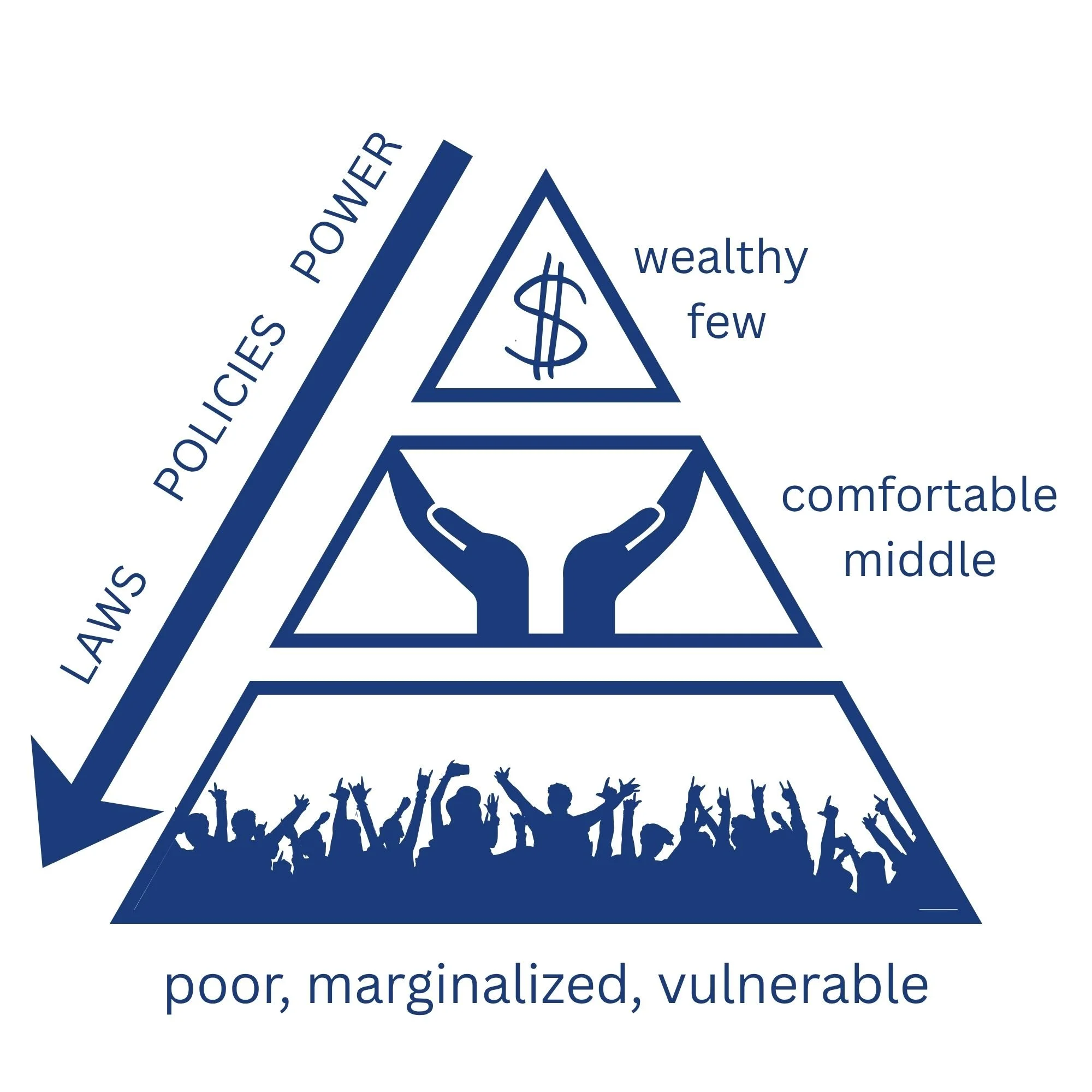
Retributive systems are hierarchical pyramids.
Power concentrated at the top, exerted downward as domination and control.
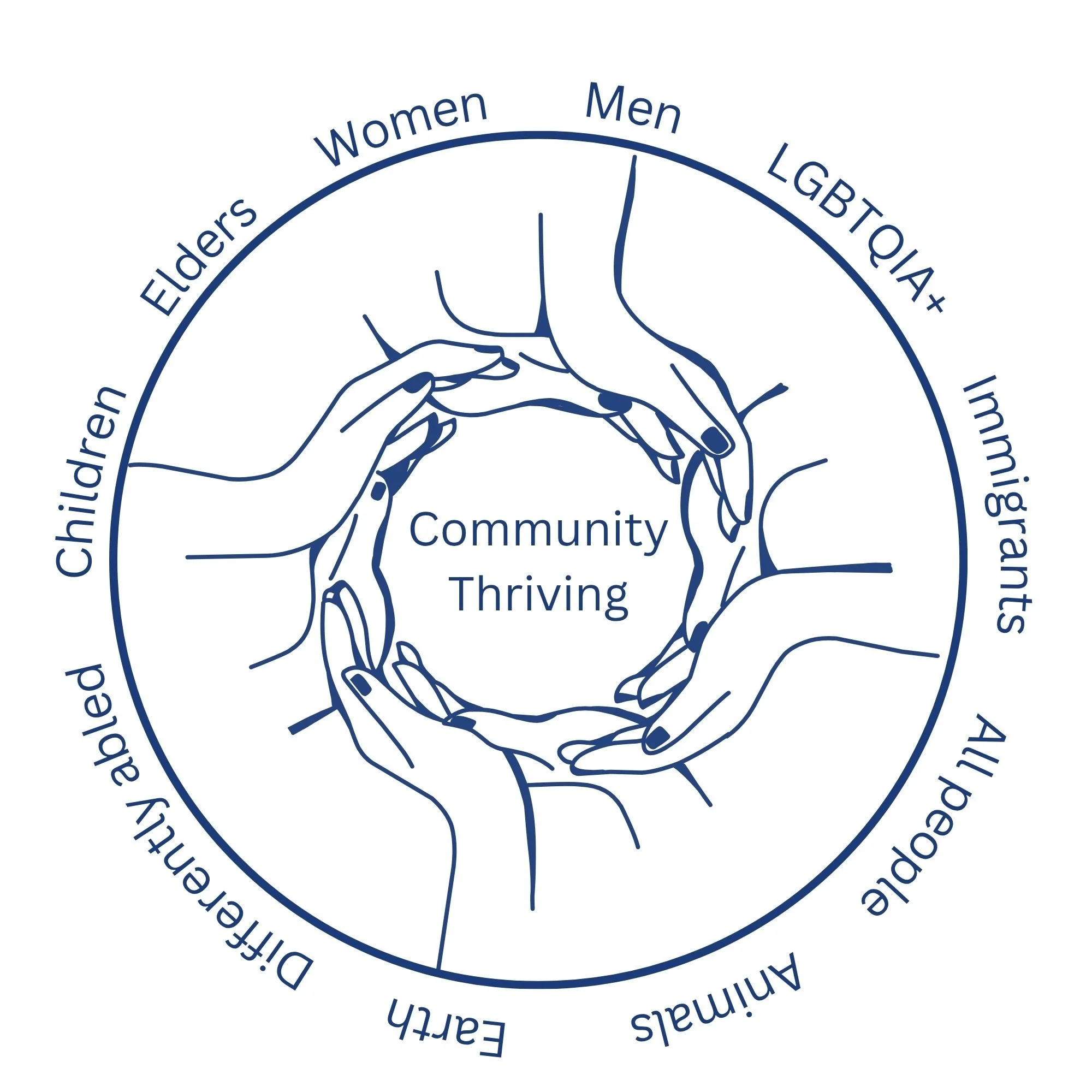
Restorative systems are circles of equity.
Power distributed, flowing across as relational community and connection.
Restorative Justice is often applied as a way to heal interpersonal harm; but Fania Davis in her Little Book of Race and Restorative Justice pushes further, suggesting that it requires a commitment to transforming the context in which the harm takes place. She urges us to adopt a more expansive view of Restorative Justice that addresses the underlying causes of harm. The success of Restorative Justice, she explains, “depends on seeing ourselves as agents of individual transformation, but also as drivers of systems transformation.”
Manitonquat, an elder of the Assonet Band of the Wampanoag Nation, names this shift directly: the way out of domination is to “replace the pyramid of domination with the circle of equity and respect.” Peacemaking circles, now used in schools, courts, and workplaces across the country, might trace their roots to the traditions of the Maori people of New Zealand and Bantu-speaking Southern African nations. Kay Pranis, a leading white restorative practitioner in the United States, learned the practice from Yukon First Nations teachers before spending decades adapting them for corrections departments, classrooms, and city neighborhoods. As the world seeks to heal from a long history of colonization, people are returning to the wisdom found in Indigenous practices that center the well-being of community over the wealth and power of a few individuals.
P2RC acknowledges the Indigenous gift of the Circle. We recognize that our work is possible because these groups have kept relational responses to harm intact despite hundreds of years of attempted erasure by colonizing forces.
What Hierarchy Requires
Colonialism intentionally separates Indigenous people in North America and across the globe from their own knowing and wisdom. In his essay “The Context of the State of Nature” in Reclaiming Indigenous Voice and Vision, James Sa’ke’j (SAHk-hej) Youngblood Henderson writes:
Four Hundred years of colonialism around the Earth was a process of conscious choice supported by manipulated facts on the part of the colonizers. These 400 years have had tragic consequences for Indigenous peoples. The consequences are more than mere conquest or the exercise of tyrannical power, slavery, and genocide; they go to forced cognitive extinction. After the British treaties, the colonizers created a systemic colonialism and racism that estranged Indigenous people from their beliefs, language, families, and identities; they deprived Indigenous people of their dignity, their confidence, their souls, and even their shadows.
Forced assimilation through the erasure of Indigenous practices is a key feature of colonialism. Colonialism persists today through corporations and the politicians whose campaigns those corporations fund, shaping policy and practices that favor the few at the top of the pyramid. This serves the needs and interests of the few rather than the many, creating a society dangerously out of balance. We see this in a justice system that values the reputation of men over the lives of rape survivors or reframes corruption by white businessmen and polititians as shrewd business practices while incarcerating Black women for the inability to pay a $100 doctor bill. Colonialism is at play in a media ecosystem that curates its narrative for particular interests, and in an education system designed to produce either compliant workers or leaders of tomorrow based on an unequal system for funding schools. It is even present in our family systems that isolate and disempower women and children by limiting their access to resources and voice.
If you're reading this as a comfortable, white, middle-class person, you might be tempted to file this under "lefty talk." That reaction is itself part of the design. The comfortable middle has been carefully built to hold up the pyramid of hierarchy. If we believe we might someday join the people at the top, we're more likely to protect them — and, just as importantly, to hold down whoever looks like competition beneath us. There are few people at the very top, and their position is precarious. They need the rest of us convinced there's room for one more. In fact, including some token representation in the seats of power helps to perpetuate the myth of meritocracy and the illusion that white men are more competent and capable.
Keeping this system in place requires punishment for those who break the rules and laws set by those in power. The criminal legal system and the prison industrial complex exist, in large part, to maintain a society where an extraordinary concentration of wealth sits with an extraordinarily small number of people. And this pattern doesn't start in a courtroom — it's rehearsed first in our schools and families, where children are isolated, excluded, shamed, and punished for making mistakes or questioning authority. Restorative Justice scholar Fania Davis names this clearly: Our current social order produces disconnection, domination, and devastation, and the work in front of us is to build something rooted instead in collaboration and belonging.
We humans have not always organized ourselves this way. Systems of hierarchy are not inevitable; historically, there have been — and still are — societies organized around cooperation, in which everyone is valued and everyone is able to thrive. The governing framework of the Haudenosaunee Confederacy of northeastern North America was built around collective wellbeing. An 1885 translation of a document called the Gayanashagowa (The Great Law of Peace) explains that a chief’s mind should be filled with "a yearning for the welfare of the people" with instruction to "make your decisions on behalf of the seventh generation coming."
In her 2024 book The Serviceberry, Robin Wall Kimmerer argues that when land or food shifts from gift to commodity, we can become detached from mutual responsibility to it. When land and people became something to extract wealth from rather than live in relationship with, the cost of simply being born changed. Extraction and private ownership now mean that from birth, most of us are already in debt for our own survival: we pay for land, for water, for food, for healthcare — all things that are, in any circle-based society, treated as basic human rights rather than commodities.
What Restorative Justice Offers Instead
This is where Restorative Justice and Practices stop being a "school discipline alternative" and become something much bigger: a working model, tested across generations and cultures, for how a system of equity-based community thriving actually functions day-to-day.
A few of its core commitments map directly onto what a post-pyramid world would need:
It relocates the question. Instead of focusing on rules and laws intended to keep the system in place, the restorative approach focuses on the needs of individuals within the community. When disruption, conflict, or harm occur the questions we turn to are: Who has been harmed? What do they need? and Who is responsible for meeting that need? That's not a technique — it's a completely different way of ordering our society.
It treats accountability as relational. In his 1963 Letter from Birmingham Jail, Dr. King wrote, "We are caught in an inescapable network of mutuality, tied in a single garment of destiny. Whatever affects one directly, affects all indirectly." Restorative Justice strengthens accountability because it repairs broken trust, safety, and relationships: it meets the needs created by harm, addresses the unmet needs that led to it, and reintegrates those who caused harm back into the community. This is King's vision of the Beloved Community, where in the end, all still belong.
It centers the people the pyramid was built on top of. Fania Davis's work insists that Restorative Justice and racial justice are inseparable — that you cannot talk about repairing harm in America without talking about the two founding traumas of genocide against Indigenous communities and slavery, and the ongoing harm those traumas still produce. Restorative Justice centers the voices and needs of those who have experienced harm. It centers the most vulnerable.
Creating the Circle Means Starting With Ourselves
Many of us unknowingly participate in and perpetuate systems of hierarchy in our own relationships, families, schools, and workplaces — not because we believe in domination, but because it's the only pattern we've known. Building new ways of being starts small, in the places where we actually have agency, and it starts with us.
adrienne maree brown, whose work on emergent strategy draws heavily on restorative and transformative justice organizing, calls this the fractal principle: how we are at the small scale is how we are at the large scale. The pyramid isn't only a structure "out there" in government and corporations, it's a pattern that gets rehearsed inside us, in a classroom, at a dinner table, in the way we talk to ourselves. Change the pattern at the small scale, and you're doing the same structural work as changing it at the large scale. This is, not coincidentally, exactly how Restorative Practices work: repair the relationship in front of you, and you've practiced the skill our whole society needs.
Take a look at the table below. The “Power Over” column lists features found in hierarchical systems where certain groups exert power over others. The “Power With” column lists features of systems that are more equitable where power is shared. Where do you notice the features of hierarchy in yourself, your family, your workplace, or community? Where do you notice features of equitable systems? Where can you begin to shift towards Power With in order to build classrooms, families, workplaces, and communities that operate more like a circle and less like a pyramid?
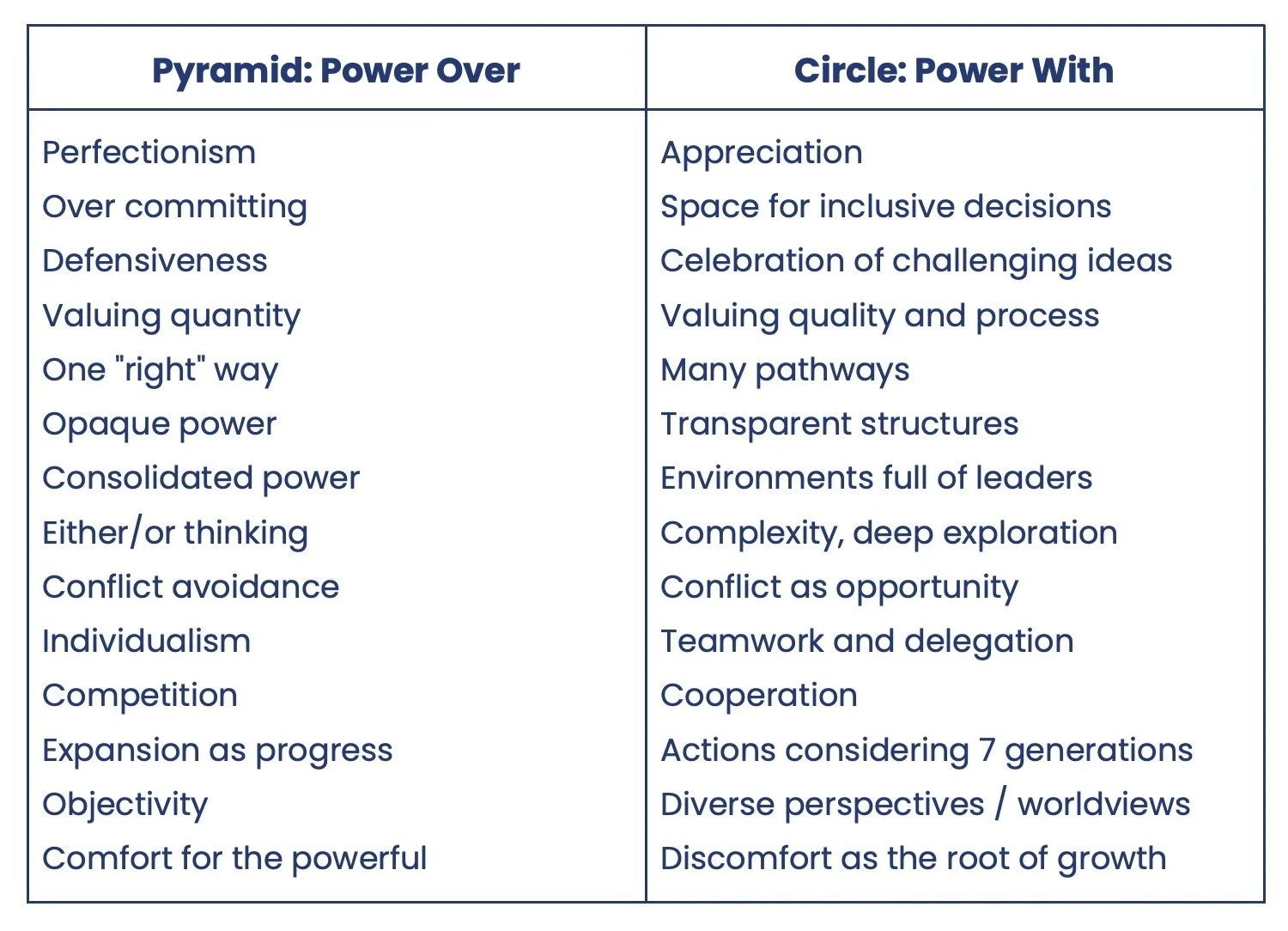
Adapted from: Tema Okun’s article White Supremacy Culture
A Longer Arc
More people are waking up to the harm that roughly a thousand years of empire, colonialism, extraction, and exploitation have done to our planet and to each other. That awakening will eventually erode the pyramid's foundation, as more of us refuse to keep holding it up. On the other side, we have a real chance to build systems that include instead of exclude, lift up instead of push down, and heal instead of harm.
What This Looks Like in Practice
Changing the system can feel overwhelming, because it is genuinely large. But those of us in the middle and lower parts of the pyramid have real leverage: we can stop individually cooperating with systems built to enrich a few.
Start with yourself–honestly examine where in your life you uphold systems of domination and control.
Get to know your neighbors–spend time on your stoop, porch, or yard. Say hello and start to build trust.
Where you can, opt out of an extractive economy–look for ways to repair, reuse, buy used, make it yourself, or borrow.
When you do need to buy something new, choose deliberately—patronize businesses with ethical labor practices and living wages, ideally small, local, and minority owned over ones built on extraction.
Vote–support candidates that value and have a record of working to create more equitable systems.
Alongside your individual choices, bring Circle practice into the rooms you already have influence in. A staff meeting. A classroom. A family conflict. Restorative Justice isn't only a response to crime — it's a whole different architecture for how humans can be in relationship with each other, one that predates the hierarchical pyramid and will very likely outlast it.
Where are you already living your life with the Circle values of community and connection? Where are you already operating in the Power With realm? Recognize that you have the ability to tear down the pyramid of hierarchy and create the Circle of community, one relationship at a time.
Further reading
Howard Zehr, Changing Lenses: A New Focus for Crime and Justice — the foundational text distinguishing retributive from restorative frameworks.
Kay Pranis, Barry Stuart, and Mark Wedge, Peacemaking Circles: From Crime to Community — on the Indigenous roots and practice of circle process.
Fania Davis, The Little Book of Race and Restorative Justice — on Ubuntu, race, and the movement's healing dimension.
adrienne maree brown, Emergent Strategy: Shaping Change, Changing Worlds — on fractals, small-scale practice, and large-scale change.
Pathways to Restorative Communities, Restorative Justice, Civic Thriving, and Dr. King’s Beloved Community
Tema Okun, White Supremacy Culture
James Sa’ke’j Youngblood Henderson,“The Context of the State of Nature,” in Reclaiming Indigenous Voice and Vision