
What are Restorative Practices? Restorative Practices (RP) are a set of structured approaches developed from the principles of Restorative Justice (RJ). Fundamentally, Restorative Practices tap into the humanity of all people to build, maintain, and repair relationships among community members.
Our Work
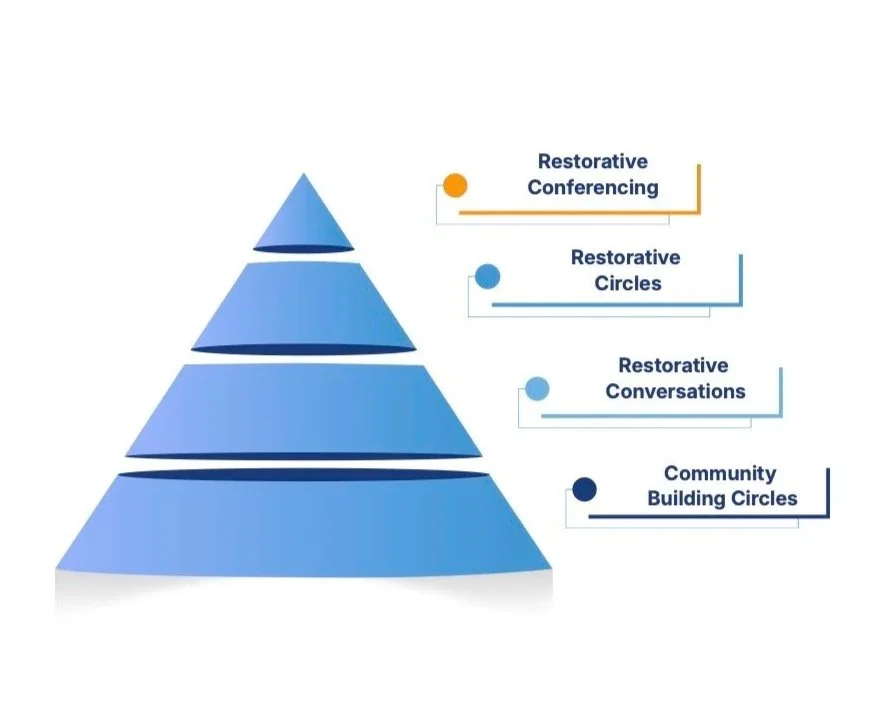
The Main Practices
Restorative Conferencing is used when serious harm has occurred. This practice is highly structured and intensive.
Restorative Circles are used when harm or conflict occurs within a community. They focus on building understanding, problem-solving, and repair.
Restorative Conversations (Chats) are an early intervention used to manage disruptive conflict in order to prevent escalation.
Community Building Circles are the foundational practice. They are used to build relationships, connection, and a sense of belonging within a community.
Restorative Practices aren’t just alternatives to jail time or school suspension.
Some people think RJ or RP must be used as a total replacement for punitive discipline, which is not accurate. Instead, these approaches:
are sometimes used in conjunction with traditional harm responses, including criminal proceedings and school discipline;
work best when they’re interwoven into our daily lives; and
can be simpler to implement than many think.
The outcomes of Restorative Practices are pretty impressive.
Restorative Practices have been proven to foster healthy dialogue and increase mutual understanding and empathy among participants, leading to an overall sense of connection. Restorative Practices increase people’s capacity to handle conflict in a way that promotes growth and repairs relationships.
A community that views healthy relationships as a central value will ultimately see fewer high-level disruptions.
Who are Restorative Practices for?
RPs can be used in any setting where people work, live, and play together, including:


Spotlight on Restorative Practices in Schools
Restorative Practices are ideal for school settings, where adults and young people can work together to find supportive ways to deal with the normal, and sometimes difficult, aspects of being part of a community. Community Building Circles are the foundational practice of this work in schools.
Restorative Practices help both students and adults build meaningful relationships with one another through explicit and implicit learning opportunities.
Restorative Practices address the inevitable conflicts that happen among young people in a way that provides accountability and support.
Restorative Practices embody child-centered education research and goals.
RPs align with and support initiatives such as:
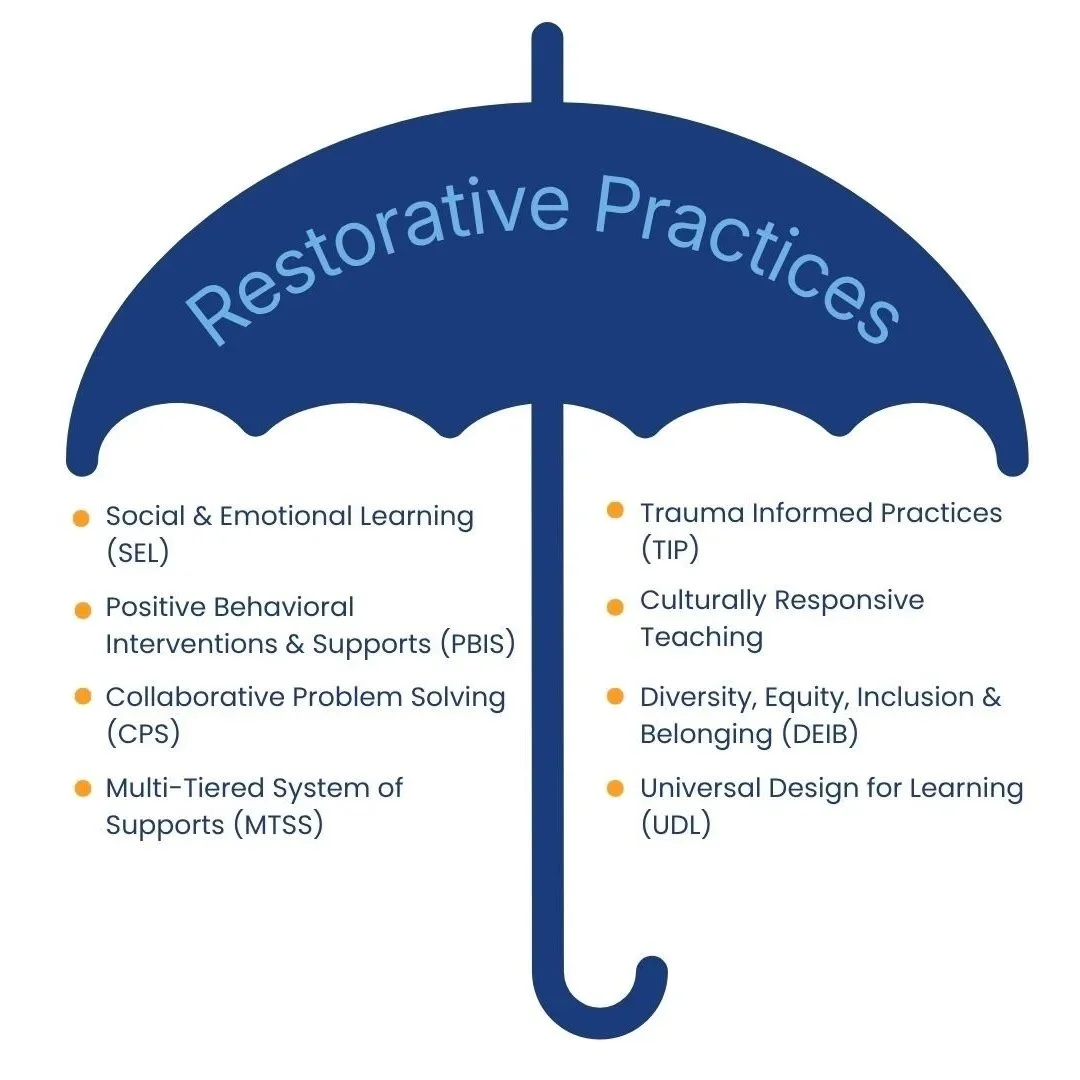
Restorative Practices support academic goals, social-emotional learning, and positive behavior.
Restorative Practices are not new. When we take a look back at education reform movements over the past 100 years we see the same ideas return again and again. You can read more about how Restorative Practices call us back to other student-centered pedagogies in our blog post from September, 2025.
How are Restorative Practices related to Restorative Justice?
Restorative Practices have grown from the “5 R’s” of Restorative Justice, where the values of relationship, respect, responsibility, repair, and reintegration provide an approach to deal with conflict and harm.
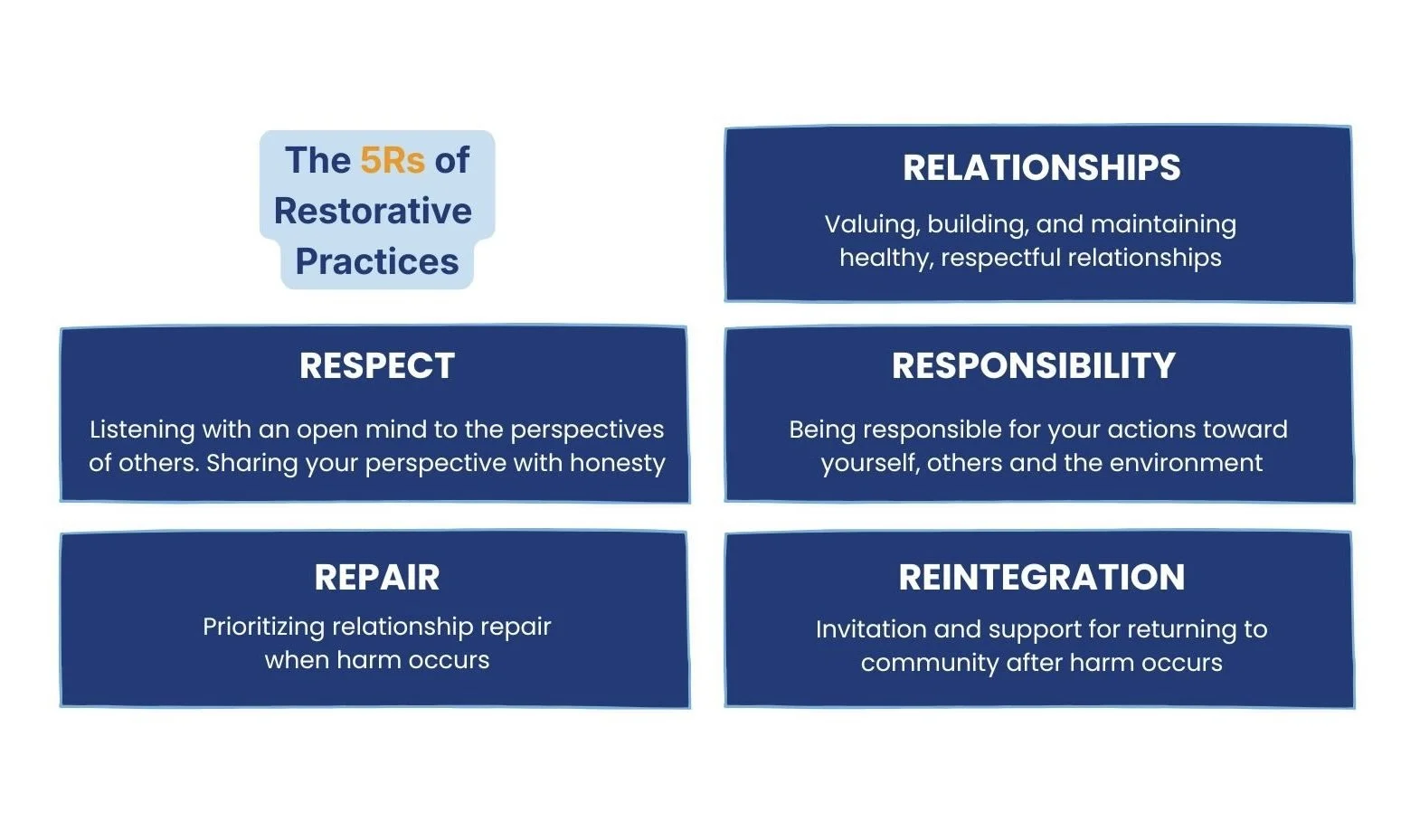
What is Restorative Justice?
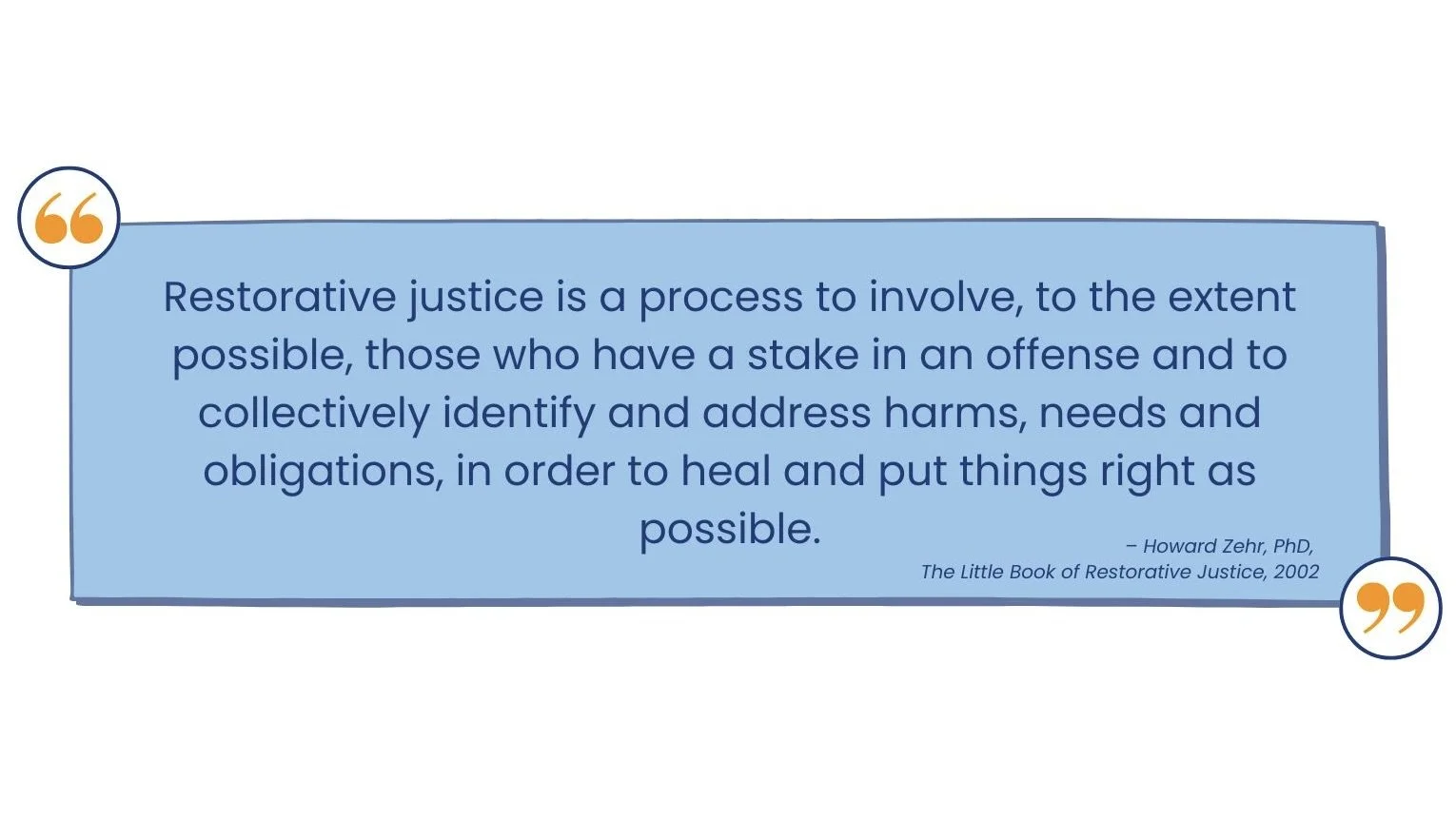
RJ shifts the focus from placing blame and punishment on a person who committed a crime to addressing the harm and the needs of those impacted by the crime. RJ changes the questions we ask when a crime has been committed or harm occurs.
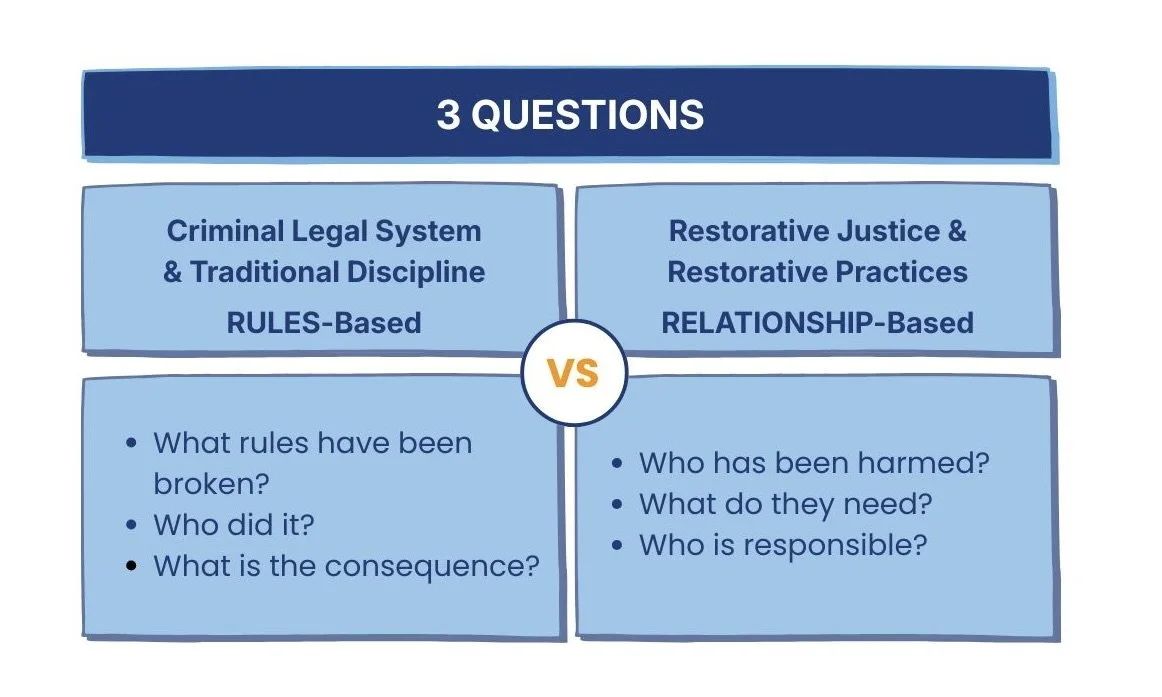
Restorative Justice:
Addresses crime and repairs harm with a community-based approach that has been practiced in many cultures around the world for ages.
Contrasts from the modern-day Criminal Legal System, which is based on shame and punishment as a response to crime. Instead, RJ leans on relationship, respect, responsibility, repair, and reintegration.
Intends for those who have caused harm to learn from the process and not repeat the offense.
Provides healing and reparation for the person who experienced harm, giving them what they need to move forward.
Follows a confidential and in-depth circle process.
Allows all parties involved in the conflict or crime to speak and be heard, and come to an agreement about how to move forward together.
Restorative Justice often leads to a greater sense of resolution, satisfaction, and justice on all sides, offering an opportunity for healing and repair.
To learn more about Restorative Justice read “Restorative Justice, What is it?” by our co-founder Candace Julyan
How can I learn more about Restorative Practices?
Follow Us:
“While I cannot claim to be an expert, after spending 18 hours training with the amazing staff from Pathways to Restorative Communities, I’m convinced that this is the most humane, progressive and common sense way to acknowledge pain, restore dignity and create long term healing in any community. The concepts have proven themselves effective in resolving conflicts in many cultures in the world and hold incredible potential for healing harm in our own schools and communities..... if we have the courage to implement them.”
—Educator, Auburn, MA
For over a hundred years educational thinkers have returned to the ideas of doing “with” rather than “to” students; the importance of community; teaching the whole person; and thinking critically about issues of power and oppression.