Restorative Justice, Civic Thriving, and Dr. King’s Beloved Community
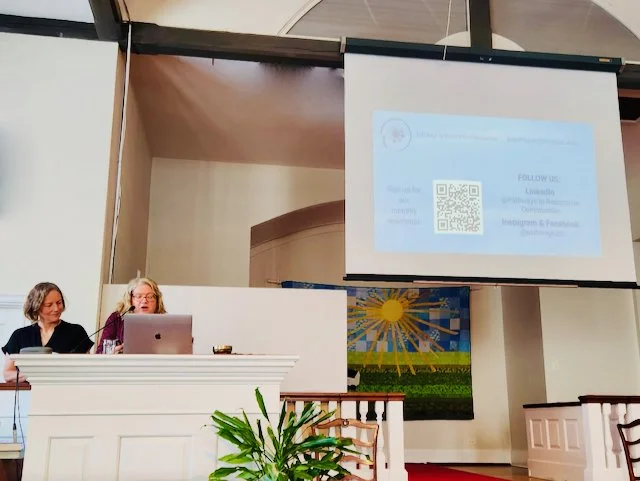
We created this blog from a presentation we gave as part of the MLK Day of Service in Melrose, MA on January 19, 2026. To read the full transcript and gain access to the slides we shared, follow this link.
Restorative Justice at its heart is about building healthy communities, and Rev. Dr. Martin Luther King, Jr. dreamed of the healthiest community of all: The Beloved Community.
As Restorative Justice educators, we understand that this work is not simply a set of practices, but a vision for how people live together in community. We see a deep alignment between the values and practices of Restorative Justice and Dr. Martin Luther King Jr.’s vision of the Beloved Community—a society rooted in dignity, justice, belonging, and shared responsibility. We also see how civic learning and nonviolent social change provide concrete pathways for moving from vision to action.
We aim to bring those threads together here: Restorative Justice and nonviolent social change offer both the mindset and the practical tools needed to build the Beloved Community; civic education supports that work; and all three—Restorative Justice, Dr. King’s nonviolent social change, and civic thriving—are mutually reinforcing paths toward the Beloved Community, where all belong.
What Is Restorative Justice? Repairing Harm and Strengthening Relationships
Howard Zehr, the grandfather of the Restorative Justice movement in the US, sums up Restorative Justice this way:
“When a wrong has been done, it needs to be named and acknowledged. Those who have been harmed need to be able to grieve their losses, to be able to tell their stories, to have their questions answered to have the harms and needs caused by the offense addressed. They – and we – need to have those who have done wrong accept their responsibility and take steps to repair the harm to the extent it is possible.”
The Restorative Justice Mindset: Values, Relationships, and Accountability
There are specific practices and approaches that people learn and use in the Restorative Justice field but most importantly Restorative Justice is a mindset rooted in core values. Restorative Justice is a “way of life” or “way of being” that places emphasis on healthy, respectful relationships with all people as a central value.
The amazing thing about a mindset is that it is a choice. At any moment we can refocus our mindset. A Restorative Mindset is a moment by moment decision to:
Be curious and open-minded rather than judgemental
Utilize strengths-based thinking and focus on opportunities instead of problems
Always treat others with dignity and respect
This mindset is grounded in values that come from Humanistic Psychology and include:
Genuineness – engaging with honesty, openness and sincerity
Positive regard for all individuals – valuing self and others for who we are
Empathy – striving to understand the experiences of others
Optimistic perspectives on personal development – believing that people can learn and change for the better
Accountability – acknowledging individual and community responsibility and understanding we are all profoundly interconnected
Dr. Martin Luther King Jr.’s Vision of the Beloved Community
In his 1963 Letter from Birmingham Jail, Dr. King wrote, “Injustice anywhere is a threat to Justice everywhere. We are caught in an inescapable network of mutuality tied in a single Garment of Destiny. Whatever affects one directly affects all indirectly.” In this quote, we see that Dr. King’s beliefs deeply intersect with Humanistic Psychology. In particular, we see a strong tie to the restorative value of how we are all profoundly interconnected, and we see this as a bridge towards Dr. King’s Beloved Community.
How does Dr. King define the Beloved Community?
All belong
All experience freedom from bigotry
All experience freedom to self-determine
All experience social equity and peace
All share in the wealth of the Earth
All belong in the Beloved Community. In a place where all belong, exclusion isn’t just gone, it is replaced by deliberate inclusion. The people we disagree with vehemently, the people who don’t look like us or think like us, they have a place in the Beloved Community.
The Beloved Community is a place of Freedom. Freedom from bigotry, racism, and discrimination, and also Freedom to act, create, self-determine, and be the person we dream about being.
In the Beloved Community all experience social equity and peace. Peace is not just the absence of violence, but the peace of mind to know that you have what you need to thrive.
Finally, in the Beloved Community all share in the wealth of the Earth. Indigenous peoples teach us that the Earth has everything that we need—forever—and that we can provide homes, medical care, and safety for all people.
Dr. King said in his 1963 sermon Loving Your Enemies: “With every ounce of our energy we must continue to rid this nation of the incubus of segregation. But we shall not in the process relinquish our privilege and our obligation to love. While abhorring segregation we shall love the segregationist. This is the only way to create the Beloved Community.”
This is where Restorative Justice principles and practices support Dr. King’s vision. Restorative Practices (such as Circles, Chats, and Conferences) provide opportunities to communicate with each other, to disagree, to make change, to help people who cause harm be held accountable, and to reintegrate them into the community. These processes hold true to the Beloved Community; in the end, all still belong.
Civic Thriving: Education, Civics, and the Path to the Beloved Community
We see social change through the lens of education, and what we’ve come to call civic thriving. Civic thriving is not something we are born knowing how to do. It must be learned!
From the very beginning, our Founders emphasized the connection between democratic citizenship and education. Thomas Jefferson wrote that the citizenry is “the only safe depository of government power.” Washington said that “Knowledge is in every country the surest basis of public happiness.”
Civics education was once embedded nearly universally in American schools, but beginning in the 1960s it declined due to loss of trust in government, growing polarization, and concerns about economic competitiveness that shifted focus toward STEM and testing.
Danielle Allen writes:
“By 2022, as a result of many decades of educational policy, the United States was spending about $50 of federal funds per student per year on STEM education and only five cents per student per year on civic education.”
We see the benefit of a path back to civics education through the implementation of Restorative Justice Practices, which promote civic skills while also addressing and repairing harm.
The History CoLab’s 18 Civic Learning Journeys and Civic Thriving
In October, we discovered a tremendous resource called the History CoLab. Through their research, the History CoLab identified 18 Civic Learning Journeys as a way to support civic thriving. These journeys include projects, activities, and experiences that build the skills needed for productive participation in society.
Learning journeys such as civil discourse on a contentious topic, conducting oral histories, and co-designing solutions are deeply aligned with Restorative Justice practices and with living in a community where all belong.
Teens, and all people, thrive when their contribution is invited and valued. Civic learning can and should happen in schools, families, athletic teams, and communities.
Dr. King’s Six Steps for Nonviolent Social Change and Restorative Justice
When Dr. King sought to change unjust systems, he followed six steps for nonviolent social change. This recipe for lasting change that leads to the Beloved Community remains relevant and important today. The six steps are:
Gather information
Educate others
Daily affirm nonviolence and accept suffering
Negotiation
Direct Action
Reconciliation
First, gather information by researching all sides of the issue. Next, educate others and engage in dialogue and debate. Then comes personal commitment to nonviolence, accepting that we may suffer (socially, financially, even physically) as we try to make change.
Negotiation follows, confronting injustice with dignity and respect and calling forth the good in others. If negotiation fails, direct action creates the moral tension necessary for change. Finally, reconciliation seeks friendship and understanding, holding people accountable while rejecting punishment.
This process reflects Restorative Justice on a macro level, and has been used around the world to make nonviolent change. The Truth and Reconciliation Commission in South Africa after Apartheid is one such powerful example.
How Restorative Justice, Civic Learning, and the Beloved Community Align
We think of Restorative Justice as a tree. The roots are the underlying values and the goals of the Beloved Community. The trunk is made up of the structures that help us embody those values: Restorative Practices, the 18 Civic Learning Journeys, and Dr. King’s six steps for nonviolent social change. Acting with these structures as guides leads to the tree’s canopy, where we have healing, belonging, and community, which ultimately moves us closer to the Beloved Community of Dr. King’s vision.
We created this blog from a presentation we gave as part of the MLK Day of Service in Melrose, MA on January 19, 2026. To read the full transcript and gain access to the slides we shared, follow this link.